


More women have financial advisors than ever before. Their confidence in their own financial lives has never been lower. The industry is asking the wrong question.
Here is the paradox at the center of American wealth management right now: women control nearly $18 trillion in U.S. assets — a figure set to approach $34 trillion by the end of this decade — and yet totumai’s 2026 research of 300 women investors found that nearly half say they hesitate to ask questions in their own advisory meetings for fear of revealing a lack of knowledge. More access, more expertise, more assets. Less confidence in the room where it matters most.
The industry’s instinct is to frame this as a pipeline problem, an education problem, or— most damagingly — a confidence problem intrinsic to women themselves. It is none of those things. The data, read carefully, points to something far more structural and far more solvable: a communication failure that the industry has been slow to recognize and even slower to fix.

The Numbers Don’t Lie — But They Are Being Misread
McKinsey’s landmark 2025 research on U.S. wealth management documents the stakes with precision. Women currently control approximately $18 trillion in U.S. assets under management, and that number is on a trajectory toward $34 trillion by 2030. But here is the figure that should stop every wealth management professional in their tracks: an estimated 53 percent of assets controlled by women are currently unmanaged — compared to 45 percent of those controlled by men. That gap represents somewhere in the order of $10 trillion in potential advisory relationships that simply aren’t being formed.
The conventional read on this is that women are disengaged or risk-averse. The McKinsey data suggest something different. Women aren’t avoiding financial advice — they’re frequently dissatisfied with the quality of the engagement when they seek it out. McKinsey found that the industry “has only marginally adapted” to the distinct goals, communication preferences, and life contexts of female investors. That is a supply-side failure dressed up as a demand-side problem.
The challenge is not that women lack financial sophistication. The challenge is that the financial industry has built an advisory model optimized for a different kind of conversation.
– Matt Schiffman, CEO totumai
Engaged, Empowered — and Still Not Heard
Here is the finding that the industry needs to sit with: Schwab’s 2025 Women Investors Survey found that 91 percent of women say managing investments gives them a sense of empowerment, and 83 percent say they enjoy investing. These are not passive, disengaged investors waiting to be activated. They are motivated, capable, and deeply interested in their financial futures.
And yet only 31 percent of Millennial women describe themselves as “very confident” in their investment strategy, despite 89 percent being at least “somewhat” engaged. The confidence deficit is not about interest in investing — it is specifically about the communication layer between women and the professionals they have hired to help them. Women are showing up. The advisory model is letting them down.
That correlation is not coincidental. It is diagnostic. When an industry intensifies its outreach to a demographic but the experience of that demographic does not improve, the problem is not the demographic. The problem is the model.

It’s Not an Advice Problem. It’s a Communication Architecture Problem.
Here is where the argument sharpens. The wealth management industry has responded to the “women and wealth” moment primarily by addressing content: more products targeting women, more female advisors, more marketing campaigns emphasizing financial empowerment. What it has largely failed to address is the architecture of the advisory conversation itself.
Women investors, across multiple research cohorts, report consistent frustrations: advisors speak in jargon-dense shorthand, assume prior familiarity with terminology, prefer to explain rather than explore, and default to a presentation mode rather than a dialogue. These are not preferences that differ slightly by gender — they reflect fundamentally different models of what an advisory conversation is for.
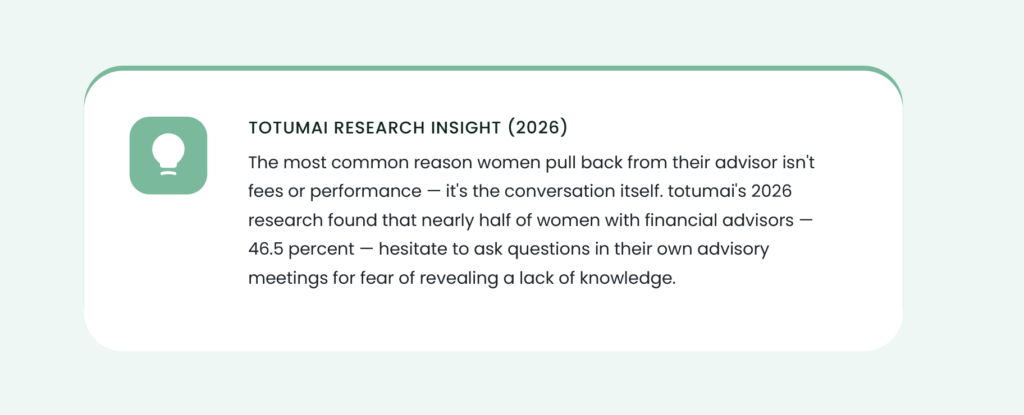
totumai’s own 2026 research of 300 women investors found that 46.5 percent of women with financial advisors hesitate to ask questions in their own meetings for fear of revealing a lack of knowledge. These are not first-time investors finding their footing — 76 percent of respondents already have a financial advisor and 35 percent hold $500,000 or more in investable assets. The self-censorship is happening among established investors. That tells you everything about where the breakdown is occurring — and it is not in the spreadsheets.
Research in psychology and behavioural economics helps explain why this communication gap matters so much. Women’s lower reported confidence in investing is often interpreted as a lack of capability. The evidence suggests something different. Studies of financial literacy and investment participation show that women frequently engage less in markets not because they lack ability, but because financial systems are harder to navigate when the language is opaque, the stakes feel high, and the interaction itself feels difficult to enter with confidence (Lusardi & Mitchell, 2014; Bucher-Koenen et al., 2017; Van Rooij et al., 2011).
In our qualitative interviews, women repeatedly described feeling unsure what questions were appropriate to ask, worried about sounding uninformed, and frustrated by explanations that assumed prior knowledge. That is not simply a knowledge deficit. It is what happens when communication increases cognitive load rather than reducing it.
The data unveils many opportunities for improvement. Among women who already have a financial advisor, 78.5 percent wish their advisor’s documents were easier to understand. Nearly two-thirds (65.8 percent) say they don’t always know what questions to ask in their advisor meetings. And nearly half — 46.5 percent — say they actively hesitate to ask questions for fear of revealing a lack of knowledge.
That last finding deserves a pause. These are not financially inexperienced women. The totumai survey respondents are established investors: 76 percent already work with an advisor, 35 percent have $500,000 or more in investable assets, and 80 percent hold a college or graduate degree. They are not hesitating because they lack experience. They are hesitating because the advisory environment has not made it safe to ask. The room has not been built for their questions.
It’s Not an Advice Problem. It’s a Communication Architecture Problem.
The advisory model was built around a certain kind of client interaction: efficient, transactional, expertise-forward. That model works for a segment of the market. But women investors tend to want something different. They want to understand the context behind recommendations, not just receive them. They want their questions welcomed, not managed. They want to feel that the advisor is orienting around their life, not their portfolio balance alone.
That pattern is consistent with what research on decision-making shows more broadly. People are more likely to engage confidently with complex tasks when they feel capable of navigating the situation, not simply when they are given more information. Bandura described this as self-efficacy: the belief that one can understand and act effectively in a given context. In finance, that distinction is critical. Women are often highly engaged with their financial futures while still reporting lower confidence in their investment decisions (Bucher-Koenen et al., 2017). Our interviews reflected this clearly.
Participants were not asking for more products or more technical detail. They were asking for clearer explanations, context around recommendations, and the ability to think through decisions without feeling exposed or judged. What they were seeking was interpretive support.

The Stakes for the Industry Could Not Be Higher
McKinsey’s January 2026 wealth management outlook projects that by 2035, women will control more than 40 percent of all U.S. wealth. That is not a niche market. That is the market. And the patterns established now — which firms women trust, which advisors they recommend, which institutions they take their assets to during the wealth transfer moments of divorce, inheritance, and widowhood — will shape the competitive landscape of wealth management for a generation.
The business case, separate from any equity argument, is decisive. Women make an average of 26 referrals to their financial advisors over a lifetime, compared with 11 for men. They are more loyal when trust is established and more mobile when it isn’t — Capital Group’s 2025 research found women with advisors are 10 percentage points more likely to stay with them into retirement than men. And 47 percent of women find their advisor through personal connections, versus 37 percent of men. Referral and retention are the twin engines of a wealth management practice’s long-term value — and both are driven disproportionately by female clients. The firms that crack the communication code are not just serving women better — they are building a structural competitive advantage that compounds over decades.
The urgency is also generational. Cerulli Associates and Capital Group project the Great Wealth Transfer from Baby Boomers will move approximately $100 trillion to younger generations by 2048. Women are positioned to be the primary recipients — inheriting assets both from parents and from spouses who statistically predecease them. The communication failures of today aren’t just a current-quarter problem. They are being written into the foundational trust relationships that will determine where the largest intergenerational wealth transfer in history lands.
The urgency is also technological. McKinsey’s 2026 outlook identifies conversational AI as a reshaping force in wealth management client experience. Women investors are already turning to AI to fill the gaps the advisory relationship leaves, often using it to walk into advisor meetings feeling more prepared and informed.

What Has To Change
The wealth management industry does not have a women’s problem. It has a communication design problem that is most visibly expressed in its relationship with women investors. Fixing it requires moving beyond the assumption that more information, more products, and more female-facing marketing constitute a solution. It requires rebuilding the advisory conversation from the client’s experiential reality outward.
One reason this redesign has been difficult is that people do not all process financial information in the same way. Research shows that individuals differ in how they respond to risk, how much information they want before making decisions, and how they evaluate choices (Croson & Gneezy, 2009). Some people prefer detailed explanations and structured analysis before acting. Others engage more readily with high-level framing and practical implications. Too much information can be just as unhelpful as too little when it creates overload rather than clarity (Iyengar & Lepper, 2000). In our qualitative work this variation was clear: some women wanted jargon translated and documents broken down step by step, while others wanted help preparing questions and feeling more confident in the meeting itself. The common thread was not identical advice. It was communication that fits how the client actually understands and decides.
In practice, this communication gap often shows up before the meeting even begins. Many women described spending time researching financial concepts privately before speaking with an advisor, trying to decode terminology in reports, or preparing questions so they would not feel caught off guard in the room. Others said they wished they had a way to translate complex financial explanations into clearer language or explore how a recommendation connected to their own goals before responding to it.
These behaviours are not unusual. They reflect a simple need: tools that help clients research unfamiliar concepts, prepare for advisory conversations, and interpret technical information so they can participate with confidence. That means advisors who are trained not just in financial products but in communication style — who understand that different clients process information, build trust, and make decisions in fundamentally different ways. It means firms that measure client satisfaction not just on returns and NPS scores but on whether clients feel heard. And it means an honest reckoning with the finding that women are deeply engaged in their financial futures — and yet still walking out of advisor meetings feeling unheard.
Here is perhaps the clearest signal of what women actually want from their financial lives: when totumai asked women what feelings would matter most after getting better financial guidance, the top answers were feeling confident (68 percent), in control (61 percent), protected (53 percent), and listened to (40 percent). Not wealthier. Not higher returns. The outcomes women most want from their financial advisory relationship are fundamentally communicative and relational — yet the industry still measures success almost exclusively in basis points.
The wealth transfer is coming regardless. The only question is which firms will have built the communication trust required to be on the right side of it. For more information about this research or to find out more please email debbie@totumai.net